

 There is a stirring of some dinosaur bones on the lists with regard to the control of neurofeedback by the professions, and in particular by psychology. It is inevitable that as neurofeedback becomes accepted that there should be an attempt by various professions to establish their turf. My own view, from my outsider perspective, is that no profession has a natural claim for proprietorship of neurofeedback, and that a turf battle will harm the field, not help it. Saying that will turn out to be as irrelevant as arguing against the adventure in Iraq, but it may be helpful to at least consider alternative futures.
Let’s start with some history. It is remarkable how little psychology has actually had to do with the development of neurofeedback, except for the fact that it utilized the technique of operant conditioning and focused on behavior both animal and human. I recall our first meeting with Barry and Lorraine Sterman in about 1989 at our house in Sherman Oaks. Knowing that we had been consorting with Margaret Ayers for a number of years already, Barry had sent me a note beforehand in which his signature was graced with horns and a tail!
During our meeting, Lorraine (a clinical psychologist) drew me aside and asked just why it was that we were claiming that neurofeedback could help with depression. This was not a question for which better data was the answer. We were talking categories here. It took a while for me to figure this out. Lorraine was clearly very respectful and supportive of Barry’s work. Why did it trouble her so much that neurofeedback could also be helpful with depression? The only viable explanation was that she considered Barry’s work to be solidly in the realm of physiology, and the seizures he was addressing were in the field of neurology. Her own field of psychology was untouched by all of this. She could go on in her dedication to psychotherapy with only an intellectual rather than practical interest in neurofeedback.
The irony in all of this is that Barry had in fact been the first to mention reports of depression lifting with SMR neurofeedback when a bunch of UCLA students did the training. This appeared in one of his early reports to his contracting agency, not in a published paper. Subsequently Barry always treated such observations as anecdotal. When Sue talked years later about addressing anxiety with the very same SMR-training, Barry demurred and said that we should do temperature training for that. Why would we insist on using SMR-training? In all of the intervening years, he had never allowed himself the observation that SMR-training systematically addresses anxiety.
Similarly, Joel Lubar’s long-standing opposition to treating childhood depression and anxiety with neurofeedback is well-known. Again an anecdote comes to mind. Two psychologists, David Bailey and Stephen Farr, once attended Lubar’s workshop some years after attending ours and utilizing our methods. When Lubar talked about carefully ruling out depression and anxiety, there was a complete disconnect with their own experience. “Treating depression and anxiety with neurofeedback is easier than treating ADHD,” they said. “Give me the depressed and anxious kids any day. You can keep the ADHD kids.”
When we first started talking about applying neurofeedback to Bipolar Disorder, there was great distress all around. I was attacked for the mere suggestion that Bipolar Disorder was treatable with neurofeedback at the Winter Brain Conference. It was again a matter of a category error, and not a question of the adequacy of our data. And some time later Judith Lubar urged me not to mention the work with Bipolar Disorder. It was just not helpful to be making such claims.
In that same timeframe I submitted a proposal to the AAPB to talk about our work with PMS. Barry was horrified. At some point along the line, the submittal was deep-sixed at the AAPB, and no finger prints could be found anywhere on that deed. There was no record of any official action to reject the submittal. Recently, a case report on PMS has been published by Elsa Baehr. We had a hundred such cases ten years ago.
Joel’s early papers emphasize the distinction that ADHD is a neurobiological disorder and by virtue of that fact the resort to neurofeedback is justified. A clear distinction was being maintained between those conditions that were physiologically driven, and those conditions that were presumptively psychodynamically mediated. The latter remained in the psychology camp.
This dichotomization was so pervasive that it also infused our own thinking. In our effort to act like good cognitive neuroscientists we largely excluded considerations of emotional regulation when ostensibly addressing attentional networks in our work with ADHD. We also put a fence such conditions as the personality disorders and regarded them as beyond the reach of neurofeedback. They remained firmly in the domain of psychodynamic psychology for quite some while. By now, however, Richard Davidson has listed the proposition that affect and cognition are subserved by separate and independent neural circuits as sin number one in his list of the seven sins in the study of emotion.
When we were on the ABC Home Show on January 12, 1993, and sent referrals to all the neurofeedback practitioners we knew about around the country, we were distressed to find that many of them did not accept the referrals unless they fit the narrow diagnosis of ADHD. This may have been an ethical way to proceed for psychologists, but it tells us also that the vast majority of conditions for which neurofeedback is helpful do not normally show up in psychologist’s offices, and even if they do, they are not readily accepted. Many professionals will not work with seizures, stroke, traumatic brain injury, Parkinson’s, and dementia. I am simply making an observation here; I am not criticizing. But this does show that psychology and the counseling disciplines only have a modest footprint among all of the conditions we believe can be helped with NF. The result is that NF remains sorely under-utilized because it lacks the appropriate professional sponsorship.
In sum, then, the suggestion that neurofeedback represents a physiologically based approach relevant to every condition of interest to psychology was not welcomed at all. That history, going over many years, therefore does not support any current attempt to assert proprietary rights. For the most part, psychologists were trying to preserve their turf from neurofeedback, not rushing to embrace it. Every new claim was resisted vigorously. Curiously, it was the QEEG that finally broke the dam. With the simple mental adjustment that neurofeedback targets EEG anomalies, and with the further simple assumption that EEG deviations have something to do with the condition being addressed, we had the equivalent of the Cambrian explosion in the neurofeedback bestiary. But this also takes us far afield from the natural turf of psychology, and the assumptions have both turned out to be questionable.
When the principles of psychology were applied to neurofeedback, it was typically gotten wrong. A “psychological model” of neurofeedback would have it that young children do not have the mental maturity to undergo the training; learning would not occur; and the results would not maintain. That turned out to be wrong on all counts. To be fair, B.F. Skinner would have argued against such propositions vigorously from the outset.
If neurofeedback is psychology, why does it look so much like a graft that is not taking? The natural conservatism of psychology reasserted itself last year with the Efficacy Document, although the less said about that the better. It raised the flag for biofeedback for incontinence in females, and stacked everything else into a hierarchy of claims with less than sterling evidentiary support. In the present context, it is relevant to point out that such a document does not make the case for the primacy of psychology in neurofeedback.
If there is a natural domain of psychology in neurofeedback, it probably lies in the realm of alpha-theta training. But the treatment of A/T by psychologists has hardly been better than that of SMR/beta training. Kamiya, the Greens, Fehmi, and Hardt all remained outliers in their chosen profession. Peniston was savaged by the biofeedback community.
And even when A/T is adopted, it morphs into an appendage of psychotherapy. Tom Allen talked about how he would monitor the physiology during A/T, and use these episodes as points of departure for subsequent debriefings. Peniston himself made abreactions into the centerpiece of his work. Nothing had fundamentally changed. Alpha/Theta, somewhat like EMDR, was a technique of provoking trauma reactions that then represented a therapeutic opportunity—much like an egret stirring the shallow waters with his foot to flush out food items. People still had to walk the hot coals of traumatic recall for their healing. The “Sturm und Drang” model of desensitization remained intact.
By the same token, therapists who swore by holding therapy for Attachment Disorder were at the same time offended at the very idea of doing neurofeedback with their charges, not realizing of course that the only worthwhile aspect of holding therapy is well embodied in SMR training, only without the compulsion and the drama. But then it is hard to let go of the compulsion and the drama.
There is huge opening here for a psychotherapy model of the disorders of attachment, one where neurofeedback could play a central role, and where psychotherapists remain essential in guiding the process to resolution. Why are psychologists not coming aboard in great droves? The answer lies in the fact that their comfort zone remains in the psychodynamic realm, and neurofeedback for them is somewhat like eating for the first time with chopsticks. I have previously written that when Marjorie Toomim encountered her most severely traumatized patients, her first resort would be to psychotherapy, not biofeedback. That remained her home turf throughout her career. The cohabitation of psychophysiology and psychology remains an uneasy one.
Meanwhile, psychologists concern themselves with trying to keep neurofeedback from falling into the wrong hands. Let me be unambiguous here: It is not in firm hands now. Not only George von Hilsheimer believes that people of ordinary competence can do neurofeedback. Lubar himself, in one of his early studies, used untutored school personnel to run neurofeedback sessions. We don’t need gatekeepers who will warn folks away from doing HeartMath on their own. We need psychologists to explore the limits of this technique in connection with Borderline Personality, addictions, sociopathy, alexithymia, Reactive Attachment Disorder, peak performance, criminal recidivism, Post-Traumatic Stress Disorder, chronic pain syndromes, etc. Lay people are getting involved because the professions have been dropping the ball for thirty years now, and are still not picking it up. Most still don’t know there is even a ballgame. And it is not an answer either to call this Medicine. The people in charge of Big Medicine are far better at asserting proprietorship than psychologists, and they are far better at garnering reimbursement.
The safest approach, then, is to regard neurofeedback as the equivalent of over-the-counter medication, or nutritional supplements. Access for all. If a turf battle ensues, psychology does not present the strongest of hands. If there is a fight it will draw a crowd, and the bullies will win. If the laity is warned off with the caution that one is dealing with medical conditions, which are the province of Medicine, one cannot then object when Medicine makes the very same case.
In an article on stem cell research, the Los Angeles Times said breathlessly that “Research is said to open floodgates of possibilities.” (LAT May 19, 2005). No doubt they were quoting someone. Everyone knows that the data are not in hand to “document” this claim. It is all puffery at this point. There are people around who are cautioning about expectations being too high for genomics and stem cell research. But it is all done with good will. No one is being bashed for claiming too much.
So why do we beat up on our own when they run the flag up on the possibilities for neurofeedback? Why are we allowing NF to be missing from the discussion when people are talking about virtual reality for panic, work with the brain-computer interface, and marvels to be achieved with implanted chips?
Let’s look at ADHD as a candidate diagnosis where both neurofeedback and psychology as a discipline have a large role to play. A cursory look at some of the issues involved in ADHD is taken in Figure 1 below.
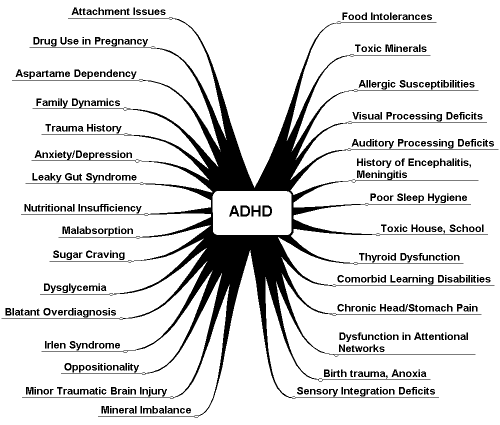
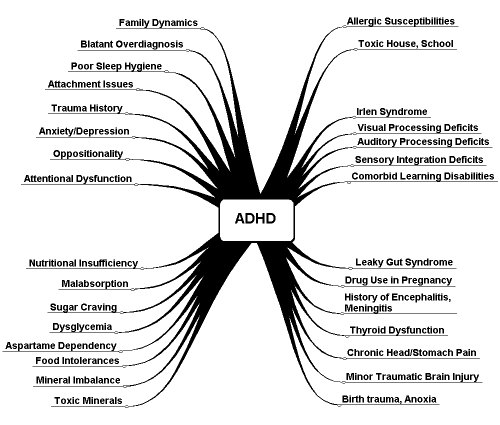
It will be observed that most of the causative or contributory influences on ADHD do not in fact lie in the domain of psychology. My own parsing of the issues is shown in Figure 2. I have segregated the issues into a medical category, nutritional issues, allergies, sensory system sensitivities, and psychological issues.
The psychology category can be further subdivided into those issues primarily accessible to physiological techniques and those appropriate to psychodynamic interventions. But here the classification needs to be more nuanced. It is shown in Figure 3. Here the psychodynamic involvement is plotted vertically, the psychophysiological dimension horizontally. I have chosen to list trauma issues and attachment issues “below the line,” where psychophysiology dominates. The rationale is that we have learned by now that the first recourse should be to physiologically-based techniques, in order to prepare the ground for later psychotherapy.
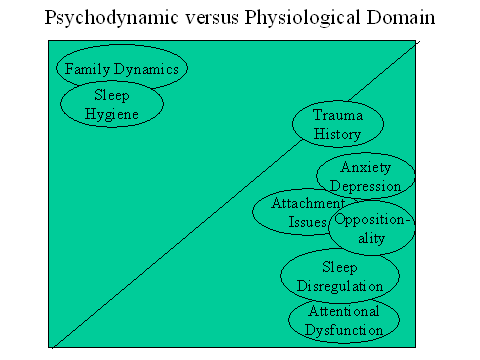
Lest people take refuge in the obviously significant category of family dynamics, let me hasten to say that we don’t find it to be much of an issue in neurofeedback success. Yes, parents can sabotage the training, and they do. But we actually do place rather minimal demands on the family in our work. We do depend on good reporting. We ask that the parents bring the child, not the nanny. But we have seen success in the face of rather tough family situations.
We are not alone in our views. In a publication on pediatric migraine, Ed Blanchard et al found similarly: “…family relationships, control, and organization were not found to exert a significant influence on treatment outcome.” [Biofeedback Treatment for Pediatric Migraine: Prediction of Treatment Outcome, by Christiane Hermann, Edward B. Blanchard, and Herta Flor, Journal of Consulting and Clinical Psychology, 65(4), 611-616 (1997)]
If there is any reality to Figures 1-3 at all, then that cries out for an integrated, cross-disciplinary approach, not only for ADHD but for a host of other conditions. The problem is not one of over-claiming with regard to neurofeedback. (Just who is being fooled here, anyway?) The problem is forcing neurofeedback into a creaky mental health care model that no longer functions, and moreover abuses people in a degrading and dehumanizing process.
Neurofeedback heralds the breakdown of the diagnostic categorization of the DSM. By being accessible to the laity it will lead to a breakdown of the traditional barriers between the laity and the professions. By being accessible to a variety of professions, it will lead to more integrated delivery of healthcare. And by virtue of being a self-regulation modality, it will lead the way into the transformation of healthcare into a system where self-care is primary. The transformation will not be a tidy one, but it will happen nonetheless.
The history of attempts to control the field of neurofeedback is strewn with wreckage. Everyone who has attempted to lock up one aspect of this field or another is ending up with ashes in their hands. Any attempt by psychologists or others to lock up this field will simply lead to the development of another path around them. The people will not be denied access to the modalities of self-care. The psychologist must win by representing value added rather than by controlling access to care. There are many ways to do that.
We are now in an age of health care at the pace of software. Moore’s Law begins to play a role here. We are also in the new world of networks and netwars. No instrumentalities of regulation can keep up with such a rate of change, with a discipline that is so capable of being a shape shifter, and with a distribution chain that is diffuse, decentralized, and network-based.
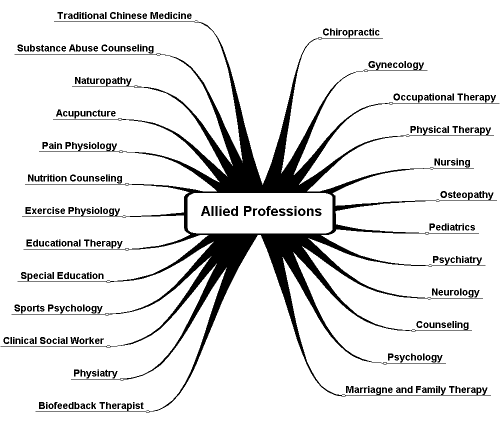
Some of the professions that will be involved in neurofeedback are listed in Figure 4.

I enjoyed reading your article – looking forward to next, Wonderful writing style. Thanks for sharing your thoughts. Got some good info from your post – ready for more! Great find. Thanks.