On “The Psychology of Neurofeedback,” by Thibault and Raz

The subtitle of Thibault and Raz’s latest diatribe against EEG neurofeedback sounds vaguely promising: “Clinical Intervention even if Placebo.” But the ambivalence implicit in the title runs through the entire article. The tone of the paper is argumentative throughout, shoring up an essential posture of skepticism with respect to EEG-NF while also allowing for the possibility that we may have been right all along: there is something to neurofeedback after all. We appear to be witnessing the last stages of resistance by these neurofeedback deniers. A subtle repositioning is going on.

Continue reading “On “The Psychology of Neurofeedback,” by Thibault and Raz”
Neurofeedback in the Biofeedback Perspective

Over the years, we have gone to great lengths to argue that neurofeedback is merely biofeedback by other means, and if anything, ILF (Infra-Low Frequency) neurofeedback is even more analogous to traditional biofeedback than standard EEG training. It works with slowly varying physiological signals, and is oriented toward the most basic regulatory functions, including autonomic regulation and arousal regulation. ILF training has clinical priorities in common with somatic biofeedback. The EEG plays only a secondary role in the actual training, and none in the ILF component. Further, the slowly varying signal also involves significant non-neuronal components. A further commonality is that it does not involve operant conditioning.

Continue reading “Neurofeedback in the Biofeedback Perspective”

Remembrances of Chuck Davis

We have lost Chuck Davis. And what a loss it is. Even among all the mavericks in this field, Chuck was an outlier. Like several other developers, he came to the field from prior work in aerospace. He was in excellent company. First there was Edward Dillingham, developer of the NeuroCybernetics; then there was Howard Lightstone, developer of the EEGer, and finally Bernhard Wandernoth, developer of Cygnet; and I had spent twenty years in aerospace research as well). In his early career, Chuck was involved with engineering control systems. Just as others have thought before him, it was natural to conjecture that the same methods might be relevant to the brain as well. After all, it faces the same issue of functioning as a control system. But it was the differences, rather than the commonalities, that turned out to matter most.

Continue reading “Remembrances of Chuck Davis”

States of Diminished Consciousness

A newly published book titled “Into the Gray Zone”, by neuroscientist Adrian Owen, delves into the mental lives of people in ‘vegetative states’ using the latest brain imaging tools. He was able to demonstrate decision-making capability on the part of patients thought to be incapable of that level of mental activity. That presupposes the existence of ordered sensory processing, first of all, which is saying a lot already. On top of that, there must be the capacity to organize a response, which calls for coordinated activity over various parts of the brain. That too is impressive — even if that response is only planned but not executed. The response is necessarily limited to activity internal to the brain. What Owen gets to see is the equivalent of what goes on in a normally functioning brain when a response is merely being visualized rather than overtly executed–like mentally rehearsing a putt. There is little doubt now that some people stuck in vegetative states are capable of organizing such internal ‘visualizations’.

Continue reading “States of Diminished Consciousness”

On the Life of Marian Diamond

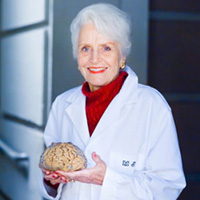
Marian Diamond, first female science professor at Cornell, and later neuroscience researcher at Berkeley, has ‘graduated out of mortality’ at the age of ninety. The research on which her fame rests was done in the sixties. At that time, she established that rats living in an enriched environment benefited vis-a-vis rats in an impoverished environment with respect to brain parameters such as cortical thickness, total brain protein, weight of occipital cortex, ratio of cortex to the rest of the brain, and the number of glial cells. The case for the existence of brain plasticity had been made—for rats, in any event.

Continue reading “On the Life of Marian Diamond”