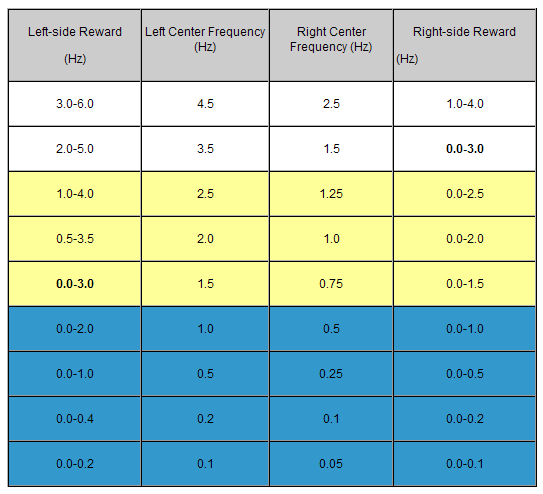
When working with reward frequencies above 0-3 Hz, we have found that a consistent relationship emerges between optimal reward frequencies for left and right-side training. If an optimal reward is found at any right-side site, such as T4-P4, then the left-side reward is expected to be at or close to 2 Hz higher. Now that we are training some people below 0-3 Hz by narrowing the reward band, this 2 Hz rule no longer applies. It is clear that left side still needs to train higher than right, but how much higher?We have used 3 Hz-wide filters above 0-3 Hz because narrower filters have slower response times. The critical variable for the brain’s response appears to be the center frequency, so we can have a very specific effect even with a rather wide frequency band. We have now found that we can narrow the filter down toward zero, and still get a strong and specific training response at these low frequencies. Above 0-3 Hz, however, we still want to continue with 3 Hz wide filters.When moving from right to left-side training with frequencies below 0-3 Hz, we do not just shift up the narrower band. For example 0-2 Hz right-side does not indicate 2-4 Hz left-side. We need to keep the lower frequency cut-off at zero and move up the higher frequency cut-off until we reach 0-3 Hz. From there the whole band can shift up.We have found our way with a sufficient number of clients training very low, that we can now look at whether any consistent relationship emerges between these very low left and right-side reward frequencies. We are in fact seeing a pattern. The appropriate left-side high frequency cut-offs are typically two times the right side. We need to allow for optimization for each individual client, but it does appear that there are guidelines that can serve as a starting point. Another way to look at this is to compare the center frequencies of the left and right-side reward bands. Below 0-3 Hz expect a left-side reward frequency two times that of the right-side reward.