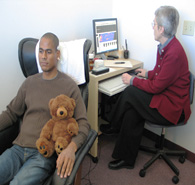
 Much proposed research on neurofeedback has faltered over the years on the issue of uniformity of approach. The protocol to be investigated needs to be narrowly constrained or the research will be criticized for a lack of specificity. We have had a number conversations over the years with researchers who were willing to give Neurofeedback research a go, provided we would give them a fixed protocol to work with. In recent years, we have been increasingly unwilling to do this, and by now the point has been reached where such fixed protocols are plainly inappropriate.
The best neurofeedback requires one to react to how the client is reacting to the training, and to make appropriate adjustments. The moment we know this, it becomes ethically questionable to proceed in a manner that sweeps such particularity under the carpet. As it happens, however, the way we proceed in practice is not very different from the way a psychiatrist might proceed in optimizing medication. The choice of medication is often driven more by side effects than by bare-bones efficacy, particularly in the case of the most common medications, the antidepressants. And in many instances medications are combined in various ways. Research by classical methods is not of help when it comes to polypharmacy, and it is not of help with regard to handling side effects. To some degree, therefore, ‘Personalized Medicine’ has already emerged in pharmacotherapy, but this has not yet succeeded in feeding back to rewrite the rules for research. A recent analysis of the status of the science at the FDA, requested by FDA Commissioner Andrew von Eschenbach, came up with the recommendation that the FDA could help to define personalized medicine. “This is the science that the FDA can really take a lead on.” [Science, 318, p.1537, 7 Dec 2007] In neurofeedback, we are in the same boat. Continue reading “Implications of Personalized Medicine for Research”
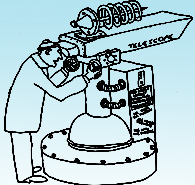 There is one field in which an extensive mutually beneficial relationship has existed between amateurs and professionals. It is in astronomy, and the phenomenon was recently taken up in Science Magazine by John Bohannon (Volume 318, 12 October 2007, pp 192-3). Significantly, this symbiosis is occurring in a science in which we have only limited ability to do experiments. Mostly the science is observational. Most of the scientific observations are specifically targeted and hypothesis-based. They are so numerous that time on the big observatories for each project is scarce and therefore precious. But there is another crucial aspect of astronomy that focuses on celestial events that are not predictable either in time or place. This is mostly where the amateurs come in. They represent a world-wide army of knowledgeable observers that is on watch every night around the globe.
  The Applied Neuroscience Conference was held in Nijmegen, the Netherlands, from May 17-20. I imagine that for many the experience was as singular and as epochal as the first Winter Brain Conference in Key West was for us in 1993. The Society for Applied Neuroscience chose not to have a conference every year, on the grounds that there would not be sufficient new material to justify the effort! But in response to this planned hiatus an ad-hoc organization formed to put on this conference in The Netherlands, which may well have the highest density of neurofeedback practitioners anywhere in the world.
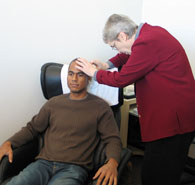 The individualization of training has had a long history in neurofeedback. It began perhaps with Joel Lubar’s choosing whether to reinforce the standard SMR band of 12-15Hz or the low-beta band of 15-18 Hz, or whether to do both in pursuit of different objectives in work with ADD/ADHD children. At our hands, it eventually became a matter of choosing whether a person should train “SMR” at C4 or “beta” at C3, or perhaps a mixture of both. There seemed to be a general tendency toward lower-frequency training at the right hemisphere. We were able to address hemisphere-specific function in a more optimized way, and we could modulate arousal level more flexibly with the two available choices.