

This year I was honored by the ISNR with the M.B. Sterman Career Achievement Award, which I accepted also on behalf of Sue Othmer. The award recognizes “thinking outside the box” as its first criterion. Barry received the award more than twenty years ago. Yet what distinguished Barry’s work is that he labored entirely within the frame of established scientific methodology, as indeed he had to do to gain recognition for his discoveries with the scientific establishment. His thinking was rooted in Pavlovian classical conditioning, migrated to Skinner’s operant conditioning, and rested on Thorndike’s Law of Effect, all from the first half of the twentieth century. He was as orthodox a Skinnerian as Skinner himself.
This made it doubly painful for him to come to terms with the ultimate rejection of his work by his academic colleagues at UCLA and in the world at large. Late in life, he lamented: “I did everything the world of science expected of me to prove this out, and in the end, it did not make any difference.” “We are making a difference, Barry,” I retorted. Our labors did not count in his mind because they would not lead to general acceptance of NF. Our non-academic status had just made things even harder in that respect. We were the wrong messengers.
Jack Johnstone once arranged for a seminar on NF that drew together the UCLA Psychology, Neurology and Psychiatry Departments. Sterman had the first slot on the program. Gripping the lectern in the Neuropsychiatric Institute auditorium, he began: “I have not been up here in forty years.” He had never been asked to present his work even in his own department.
There is one leap out of paradigm that Barry was compelled to undertake, and the results have been consequential. Once the method became well established through the extensive research with cats, his Polish colleague Wanda Wyrwicka told him firmly, “Barry: You have to do this with people!” The transition to working with human subjects meant translating the protocol from cats to the human EEG. This was not straight-forward, because the human EEG was not characterized by the unambiguous bursting activity seen in cats during motorically idle states. Rewarding high-amplitude excursions in the SMR training band was the available alternative, and the best argument in its favor was that it actually worked.
If B.F. Skinner had been looking over Barry’s shoulder at that time, he would have said, “there is no event here to be rewarded.” He would have disapproved. In the case of the cats, the event was so readily discriminable that one could have varied the detection threshold over a wide range without significantly altering the results. Not so with human subjects. The outcome was ever so sensitive to even slight changes in threshold. Truth be told, we were in mushy terrain.
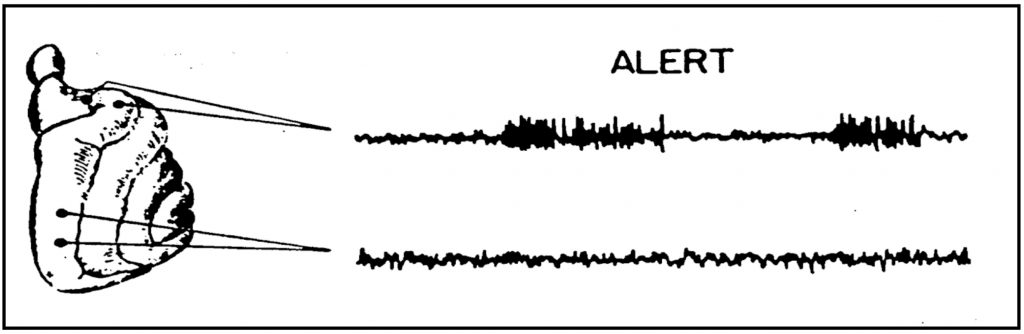
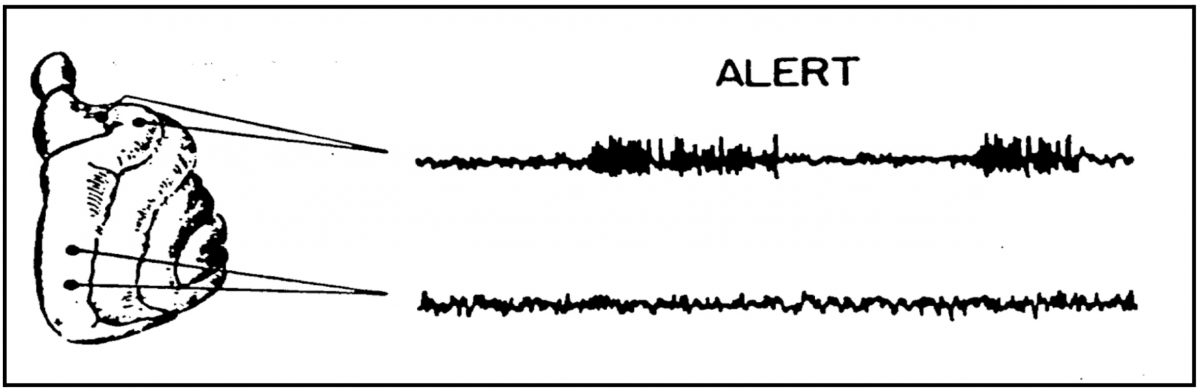
Figure 1. Waking EEG of the cat in a state of motoric stillness, which allows us to see the spindle-bursts at sensorimotor cortex—and only there.

Figure 2. Cat EEG in a state of light sleep, showing sleep spindles, which are the direct analogue of the spindle-burst activity shown in Figure 1.
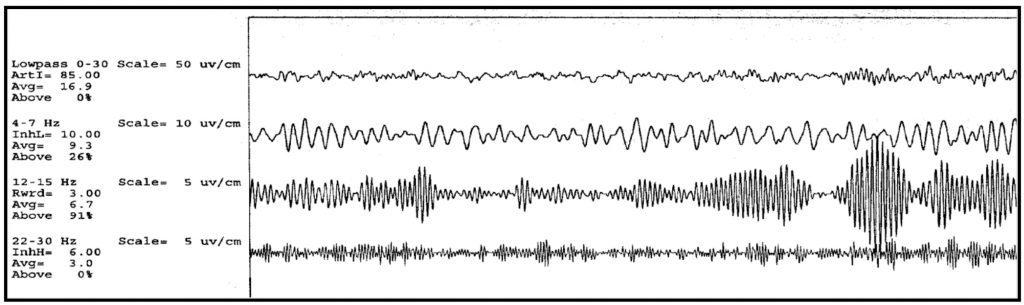
Figure 3. Human EEG showing a sleep spindle, the direct analogue of the sleep spindle in the cat, occurring within the same narrow frequency range. Underlying mechanisms are similar. These data were acquired with our first-generation system, the NeuroCybernetics.
Barry had undertaken two designs, the extinction design and the reversal design, to prove out that operant conditioning was effective with the cats. The evidence was robust; the hypothesis was confirmed. But if one envisions translating those same designs to human subjects, it becomes apparent that they would very likely fail to confirm the hypothesis.
It was also problematic that when we later trained for the expected increase in SMR amplitudes, we often did not observe any such increase. The changes in band amplitude were not correlated with clinical results. In effect, the highly successful work with the cats had cast an aura of legitimacy to the procedure with human subjects that was undeserved on the merits, even though clinical results were being obtained. This also had the effect of freezing our model understanding.
Meanwhile, Margaret Ayers, who became acquainted with the method as Barry’s lab assistant, decamped to set up a clinical practice just down the hill from Barry’s house in Beverly Hills after Barry dismissed her from his laboratory. Not having been formally trained, she was never schooled in rule-bound conduct as a clinician. Over the years, clinical experience with many brains shaped her behavior to be ever more generous with the discrete rewards of the operant conditioning design. This violated the strict rules that Sterman had insisted on for the method.
The practical consequences were hugely favorable, however, with improved outcomes and enhanced training efficiency. Yet there was no accompanying theoretical frame within which to understand this new reality. It is directly apparent, however, that the new approach further demolished the conception of the discrete reward as indexing any kind of brain event that merited recognition.
My own training back in 1985 at Ayers’ office firmly established that the benefits I derived could be traceable solely to the fact that I was watching the within-band dynamics in the low-beta band. The discrete rewards had nothing to do with it. (See “A revisionist view of Neurofeedback,” https://news.eeginfo.com/a-revisionist-view-of-neurofeedback/ ). Yet our early work with severely impaired victims of near drowning demonstrated, in turn, that infants could respond equally well to training only on the event stream of the beeps. The discrete rewards had lost their individual significance; their meaning emerged only within context.
Plainly, the training was no longer event-focused. The brain was now exposed to a signal stream that reflected the low-frequency dynamics of the training band. In retrospective view, this can be seen as a precursor to our later adoption of infra-low frequency training. It had become utterly clear that the brain was engaging with the dynamics in both signal streams—the within band and the low-frequency dynamics.
Finally, if in a thought experiment one imagines translating the Ayers innovation to the cat research, the results would have gotten worse, if anything, and certainly not better. The implications are clear: Operant conditioning was the proper research design for the cats, but it was inappropriate to the SMR-training of human brains.
Individually and collectively over time, the human brain had effected a prison-break from the stultifying research design that was more suitable for rats, cats and pigeons than for the human brain. (Barbara Brown had already come to this view back in the seventies, saying that operant conditioning was an inefficient way to train the brain.)
Barry never came to terms with this new reality, and neither did Joel Lubar. As late as 2011, they subscribed to the view that “It is our contention that future applications in clinical work, research and development should not stray from the already demonstrated basic principles of learning theory until empirical evidence demonstrates otherwise.” (Ref.) This was an admonition from our founders to labor ‘within the box’ even as confounding empirical evidence was already plentiful and mounting. This was a reactionary posture for the time, more of a last line of defense for a disintegrating paradigm.
Joe Kamiya, Barbara Brown, Elmer and Alyce Green, Barry Sterman and Joel Lubar were the right people to establish this field on a solid footing, and they did so at some considerable cost to their careers. But Barry and Joel did not oppose the imposition of a kind of lockdown of the intellect that constrained innovation rather than allowing it to flourish.
As it happens, my own experience of the training as depending entirely on the within-band dynamics of the training frequency (16.5 Hz in my case) was only possible because Margaret Ayers was using Barry’s first-generation laboratory design, in which the dynamics registered by way of the fluctuating intensity of a green light. In his subsequent instrument design, the football game, Barry chose to render only the discrete rewards visible to the trainee. Thus, Barry had foreclosed the chance of discovering what I had learned from my own training.
By way of instrumentation design, Barry had locked himself into stasis. For the rest of his professional life, Sterman relied on the training protocol that he first developed for application to human subjects. This served only to heighten his skepticism of what others were doing. He was never an “outside-the box” thinker himself, and from his position of authority he also assailed those who left the reservation.
The operant conditioning model for SMR-beta training was a viable starting point, but it was superseded in both clinical effectiveness and training efficiency by Endogenous Neuromodulation, which engages the fast and slow dynamics of the target frequencies. This is what set our first-generation instrumental design, the NeuroCybernetics, apart from the very beginning. It is ironic that Barry himself had facilitated the migration from operant conditioning to Endogenous Neuromodulation that he could never accept.
Siegfried Othmer
Reference: The quotation is from a review paper titled “Neurofeedback and basic learning theory; implications for research and practice,” published in 2011 in the Journal of Neurotherapy and authored by Leslie Sherlin, Martin Arns, Joel Lubar, Hartmut Heinrich, Cynthia Kerson, Ute Strehl, and Barry Sterman.
