

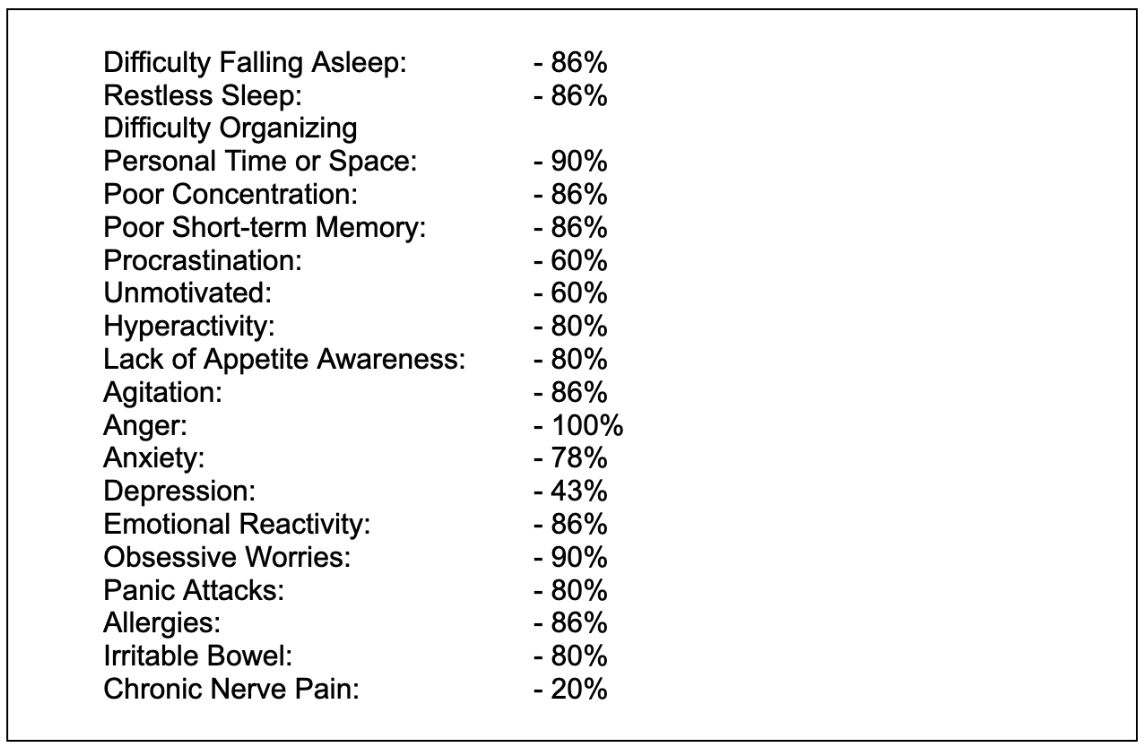
A Case of Chemical Injury and PTSD
by Carolyn McLuskie, MA, RCC and Siegfried Othmer, Ph.D.

When someone comes for neurofeedback with severe symptoms, we are not likely to be confronted with a single, narrowly definable issue. In cases of chemical injury that significantly compromise health and functionality going forward, the issue is inherently complex because it quite naturally evokes a trauma response as well. The dearth of available remedies makes for dim prospects. And if that occurs in a person with a history of early emotional trauma, this additional ongoing trauma is a compounding factor on what is already a problematic presentation.

Continue reading “A Case of Chemical Injury and PTSD
by Carolyn McLuskie, MA, RCC and Siegfried Othmer, Ph.D.

Hudspeth’s Method of Coherence Analysis

In Hudspeth’s method, coherence values derived from 19-electrode QEEG data collection are used to generate a graphical display which consists of a three-dimensional depiction of a cube-like space in which little circles float, something like fish in a fish tank. Upon closer look one sees that there are 19 such circles, each labeled as one of the 19 QEEG electrode sites. In general, the circles tend to cluster fairly close to one another; but at times a particular circle stands out because it floats at a distance from the others. As Hudspeth explained, when a circle stands out from the others, it identifies an electrode site that has a problematic pattern of coherence relationship with the other sites. Continue reading “Hudspeth’s Method of Coherence Analysis”

By Law or Grace

Glen Martin has been involved in neurofeedback since 1993. He happened to be home sick on January 12 th of that year, and tuned in to the Home Show at which we demonstrated our neurofeedback instrument. The economy was in the doldrums at the time, and his own office finances were iffy, but nevertheless he took a gamble on neurofeedback and became one of the early members of the EEG Spectrum affiliate network. The principal driver was the identified ADHD of his son, whose training eventually turned into quite a saga. His daughter benefited as well, and ultimately his father also.

Both Glen’s professional and family involvement with neurofeedback have been quite remarkable adventures, and I will return to these below. But in a further turn of events, Glen became more and more concerned about the “parenting deficits” that he was seeing among the desperate families coming to him with their oppositional and bipolar children. Eventually Glen decided to make that his focus rather than the neurofeedback. The result is a new book that he has just self-published, titled “By Law or Grace.” Continue reading “By Law or Grace”

Neurofeedback and Other Interventions for Patients with Ritual Abuse, Mind Control, and Dissociative Disorders

Author: Susan Ford, BA, BCIAC-EEG, Tryon, North Carolina

Abstract

Ritual Abuse and Mind Control are often misunderstood in professional circles and as a result patients diagnosed with DID caused by ritual abuse and mind control often have trouble finding proper care. This is at least partly the result of the controversy that has dogged this field. By means of legal processes the entire field of study has been called into question, and clinicians specializing in the remediation of DID have been discredited. Mental health specialists have been accused of excessive zeal in unearthing presumptive early childhood trauma, and the malleability of memory has been used to discredit such clinical reports wholesale.

It is therefore appropriate to review the basis for the existence of systematic, deliberate early childhood abuse, and for other mind control techniques of considerable reach. The need for secrecy with respect to such techniques by perpetrators, and the natural skepticism that nearly everyone else brings to the topic, makes it exceedingly difficult to document and prove the full scope of such troubling activities. Continue reading “Neurofeedback and Other Interventions for Patients with Ritual Abuse, Mind Control, and Dissociative Disorders”

Where do we go from here?

Author: Tom Allen

Last week’s newsletter about the Efficacy Document was widely distributed to the neurofeedback community at large. It gave rise to a discussion on the Biofeedback list which is still continuing. Tom Allen responded with a longer piece that is reproduced below in slightly edited form. Some introductory material is presented first.
Where Do We Go From Here?

Steve Rothman wrote:
Siegfried,

You say in your note below:
“The efficacy document is a clear declaration of war against most of what we do
on a daily basis.”

To which I respond:
I think the above statement is over the top … Continue reading “Where do we go from here?”

Video Games are Oceans Apart

Author: Mark Steinberg

Video games have become a staple in the American sensory and entertainment diet. The interactive animated electronic screen prevails over games and entertainment the way word processing software has essentially replaced typewriters. If video games are the fast food of the mind, then there is mounting evidence that we are filling minds with unhealthy junk and supersizing the delivery to boot. In contrast to other pariahs of the modern age, video game phenomena are largely skewed toward the younger population, particularly children and adolescents.

It is estimated that a staggering 92 percent of young people tune into the virtual worlds of electronic entertainment purveyed on computers, arcades, and electronic gaming devices. In 2003, computer and video game sales generated a whopping $16.9 billion! Amidst the hoopla of retail frenzy and controversy about video games, it mostly escapes the professional and lay communities alike that there are video games specifically designed and proven to reduce the risks often associated with and attributed to the video genre. Aside form aesthetic or thematic appeal, video games are not restricted to a single stratum commercial wave that engulfs and drowns its players in a tsunami of mindless capitulation. Continue reading “Video Games are Oceans Apart”