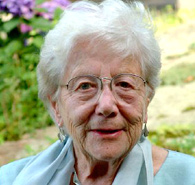
 The death of Florence Wald at the age of 91 is a moment to reflect on the extraordinary change she has worked as a pioneer of hospice care. As a Dean of the School of Nursing at Yale, Wald was troubled by the exclusive focus on cures, with little regard for the wishes of the patient or his or her family about ongoing care. She became acquainted with St. Christopher’s, the first hospice in England that was established by pioneer Cicely Saunders. After quitting her position and spending time at St. Christopher’s, she then established the first hospice in the United States in 1971, which in time became the model for hospices everywhere.
Wald had a larger vision, however. “Hospice care for the terminally ill is the end piece of how to care for patients from birth on,” she wrote. It is this vision that needs to be carried forward, and that has particular implications for us in neurofeedback. In hospice care we have a more balanced view of the needs of the patient. The focus is on maximizing the quality of life rather than mere avoidance of death. It involves the family fully, and relies on home care as much as possible. In this setting, there is a softer boundary between the care givers and the care consumers. Continue reading “Florence Wald”
 The program of the Northeast Regional Biofeedback Society Fall Conference, convening on the grounds of the former Women’s adjunct college of Rutgers University in New Brunswick, NJ, quite possibly pointed the way to our near-term future, namely the mutual accommodation of the biofeedback and neurofeedback perspectives. The one-day conference was preceded by an all-day seminar on Heart Rate Variability (HRV) training, conducted by Paul Lehrer, Bronya and Evgeny Vaschillo, and Maria Karavidas.
  Americans universally express appreciation for the service of our troops overseas. Yet so little is done to support the re-acclimation of our courageous soldiers upon their return home. This problem, which has been with us through many wars, will be exacerbated in the near future with the impending return of tens of thousands of veterans from Iraq — many of whom have served multiple tours of duty.